🏆 SF Design Awards 2026 — Student Category Winner
🏆 Graphis New Talent Awards 2026 — Honorable mention
Overview
Cosmic Legends is an interactive storytelling tool designed for touchscreen kiosks that lets users explore how cultures across the world interpret the same stars.
Problem
Astronomy tools today largely overlook cultural interpretations of the stars, reducing them to scientific data. This leaves most users unaware of the diverse stories and meanings cultures have associated with the night sky. Cosmic Legends addresses this by shifting focus from pure science to shared storytelling.
Solution
Cosmic Legends is a culturally inclusive, interactive platform that invites users to explore the same star through multiple cultural lenses. By blending storytelling, motion, and voice, it transforms stargazing into a myth-sharing experience that fosters understanding and accessibility.
Business Goals 🎯
Design an interactive educational experience exploring cross-cultural interpretations of the star Betelgeuse.
Engage users through animated storytelling, voiceover, and accessible design.
Foster curiosity, cultural understanding, and meaningful learning across diverse audiences.
Design Process
Research & Discovery
Conducted cultural research on Navajo, Tupi, and Japanese interpretations of Betelgeuse; gathered user needs and accessibility requirements.
Ideation & Design
Created wireframes, visual designs, and interactive prototypes with animated transitions, voiceover scripting, and caption integration.
Prototype & Testing
Built a high-fidelity interactive prototype in Figma, optimized for a large-format kiosk, and iterated based on user feedback and accessibility audits.
Research and Discovery
These insights revealed an opportunity to design a tool that makes room for narrative plurality and visual clarity.
Primary Research: Conversations with educators, astronomy lovers, and students unfamiliar with Indigenous sky knowledge.
Secondary Research: Scholarly work on ethnocosmology, visual anthropology, and UX for accessibility.
Accessibility Audits: Using voiceovers to ensure usability for deaf and visually impaired users.
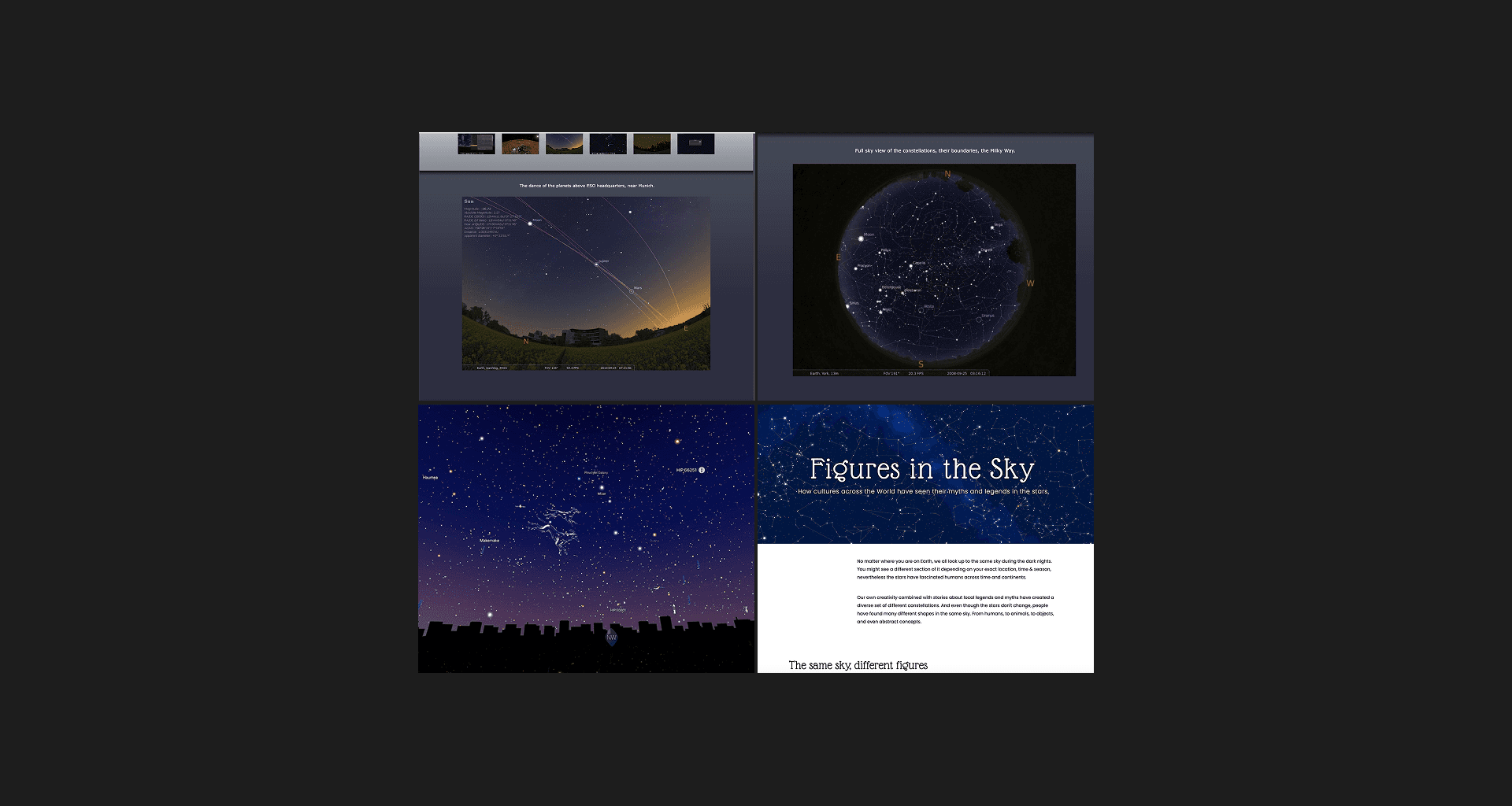
Competitive Review: Examining apps like Stellarium and Night Sky revealed a heavy focus on Western science with minimal cultural context.
Visual Inspiration
A major visual and conceptual influence came from the TV show Moon Knight, where ancient Egyptian mythology, glowing constellations, and shifting skies are used to visualize memory, myth, and identity.
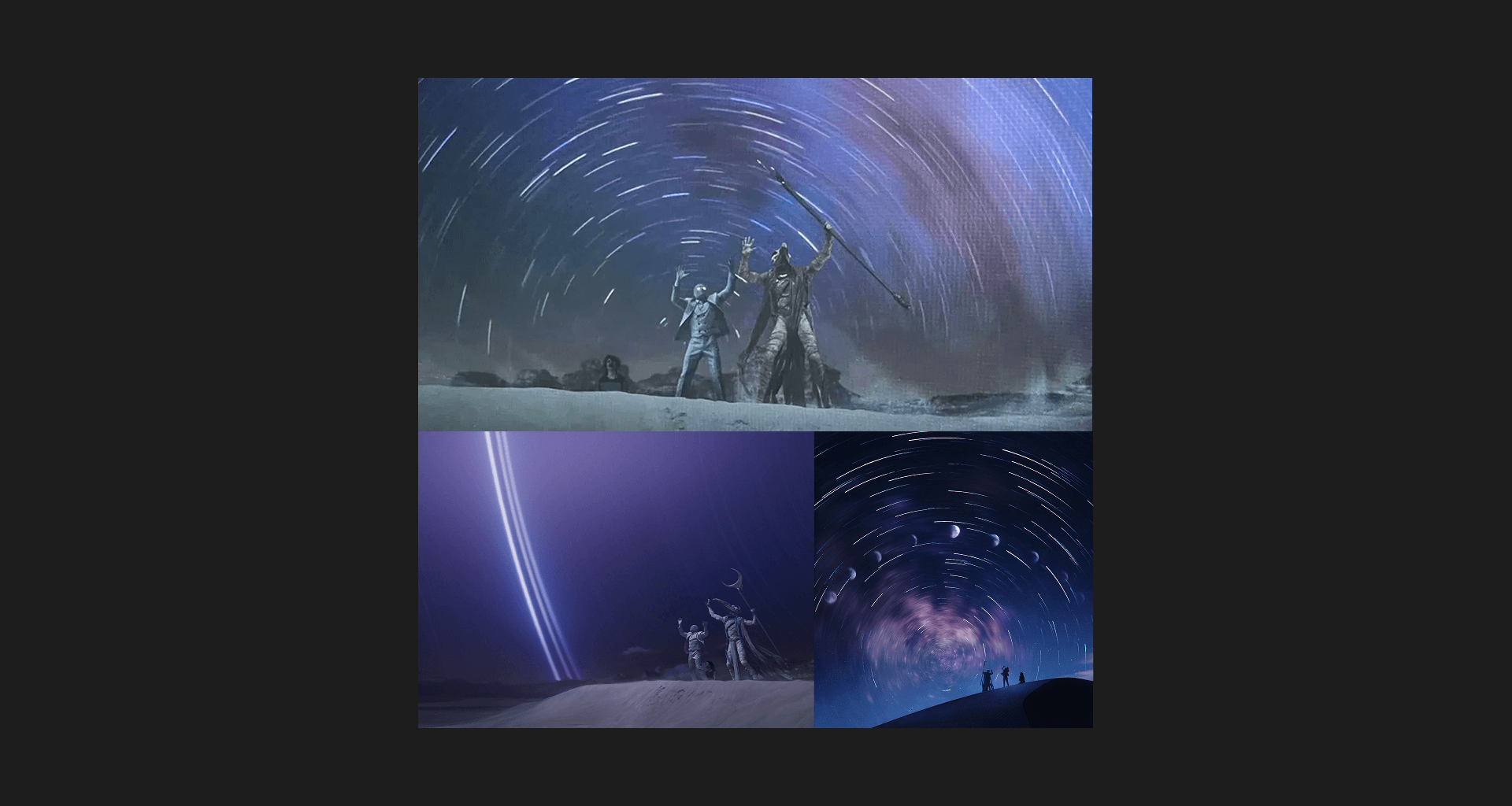
Scene from Moon Knight
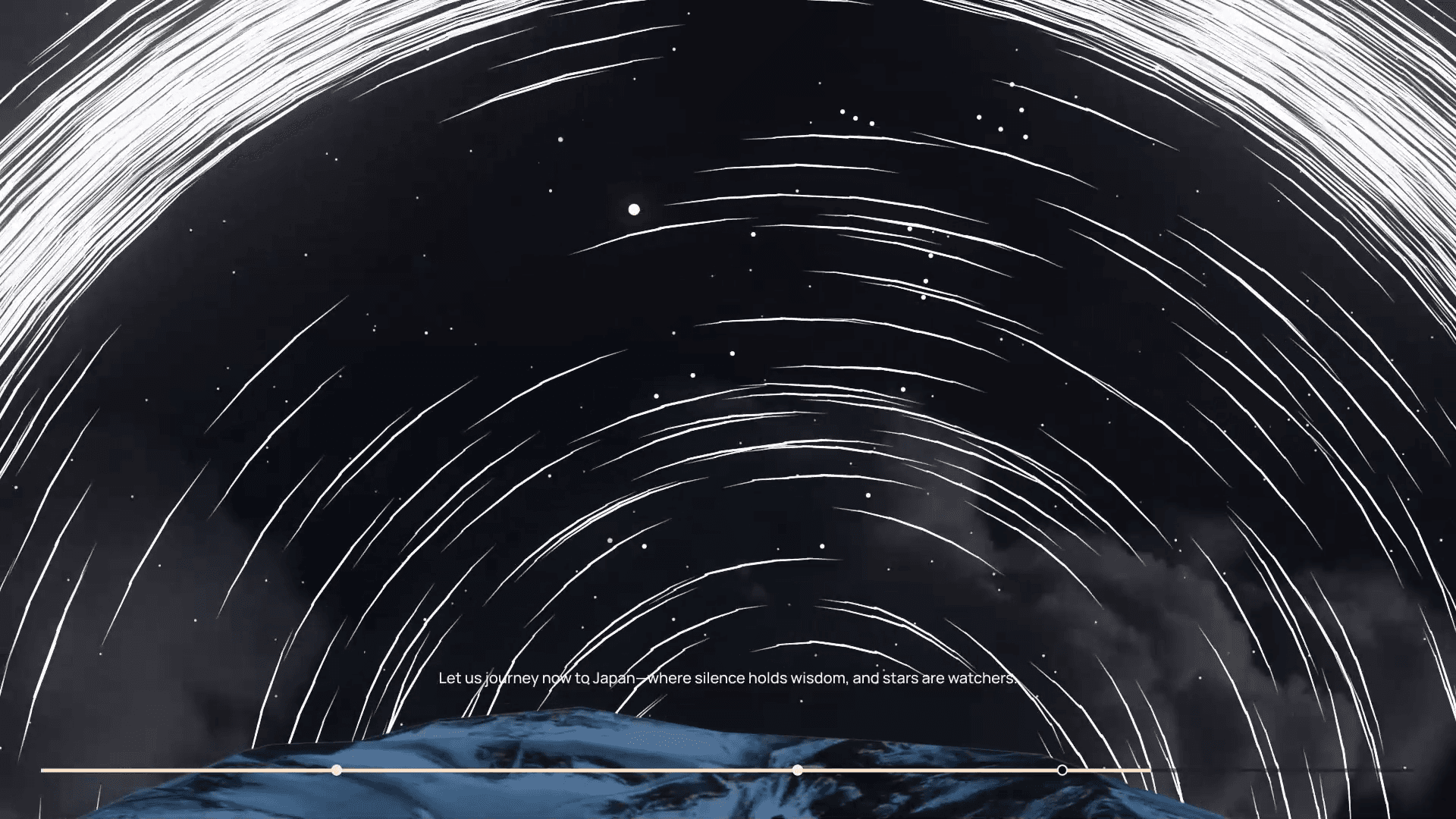
My design
Creative Process
With a strong focus on technical experimentation, this phase was guided less by traditional storyboarding and more by hands-on discovery. From particle behavior to sound sync, each design choice was stress-tested directly in 3D and motion tools like Cinema 4D.
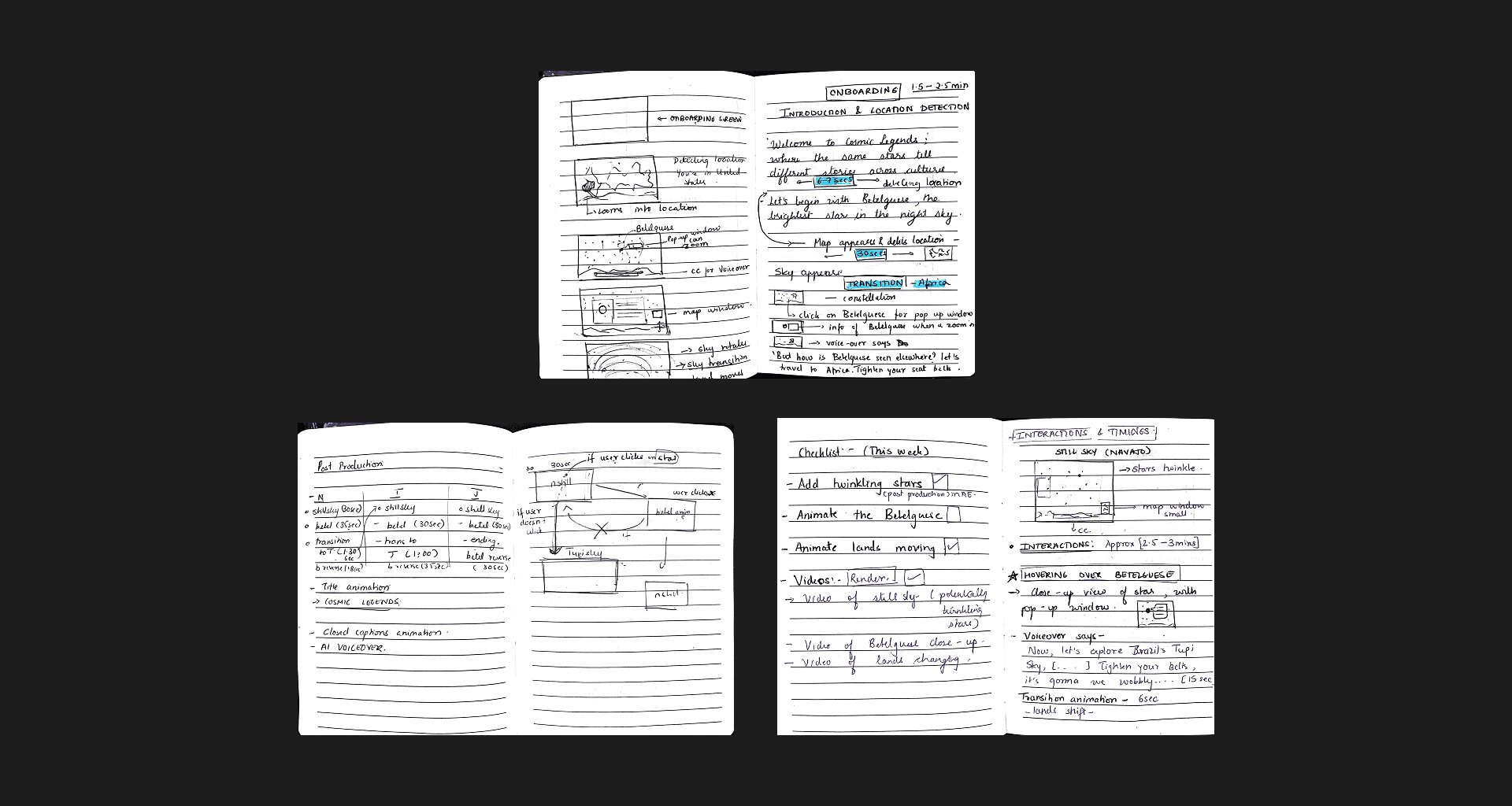
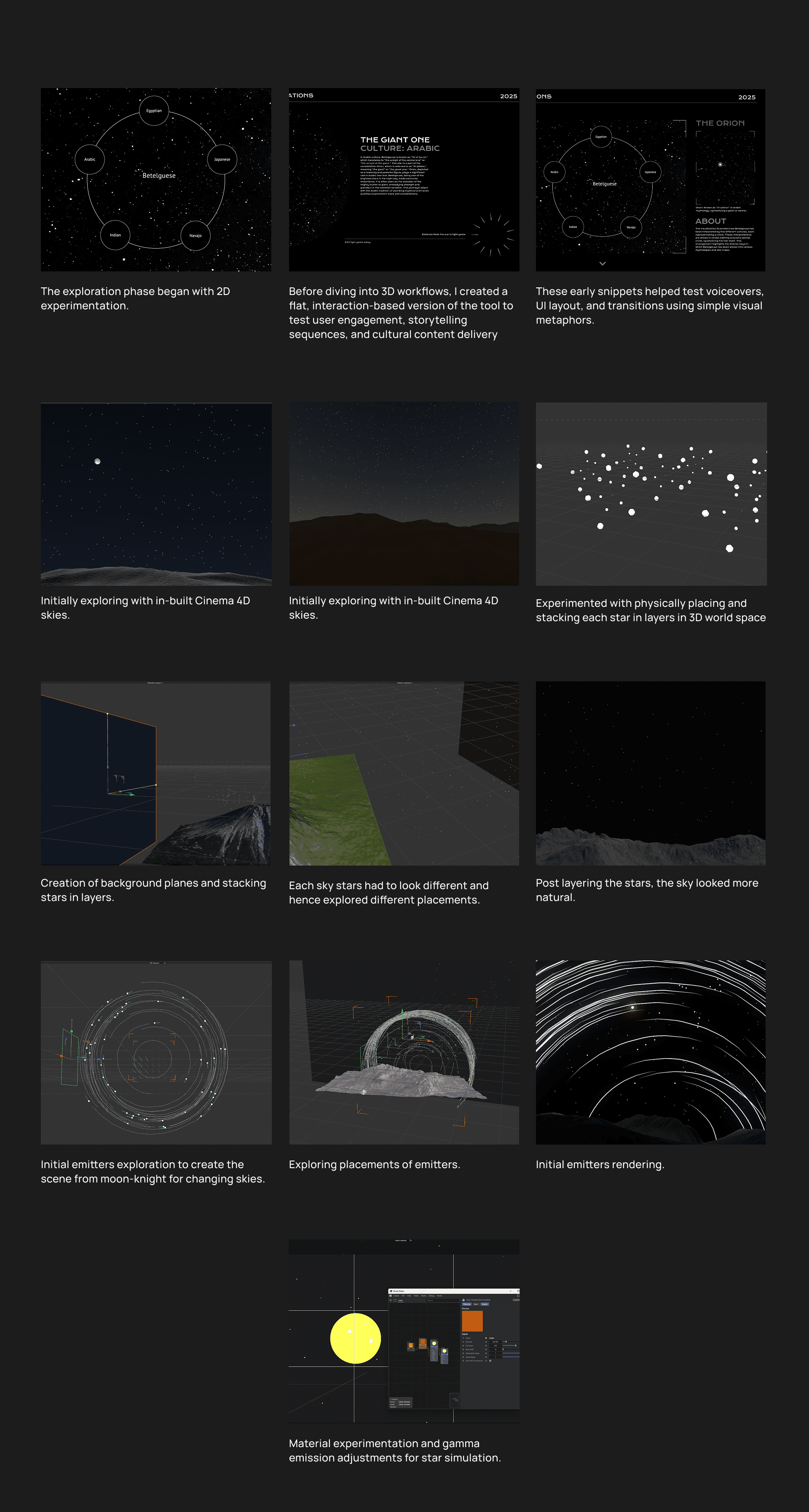
User Journey
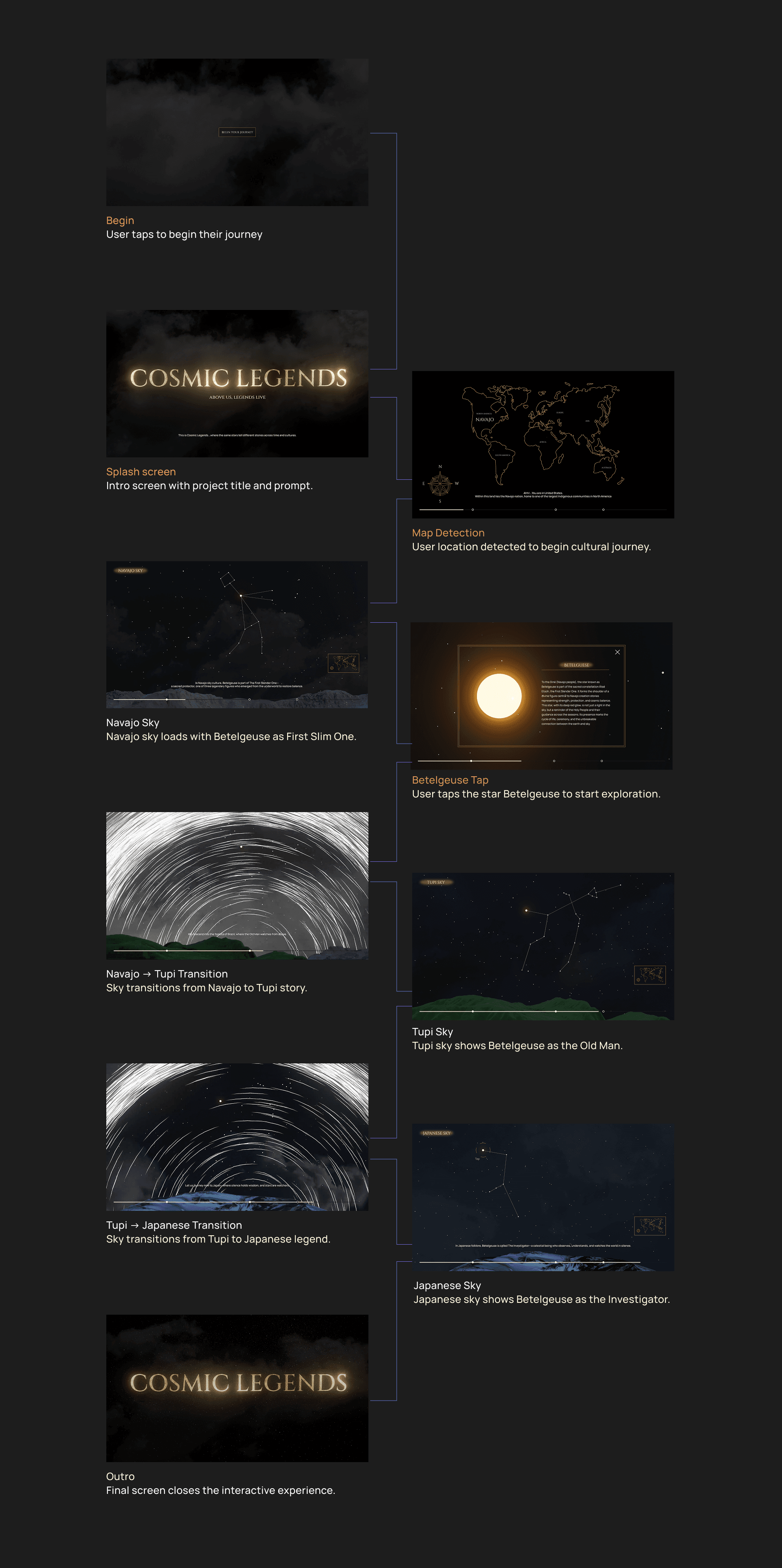
Design Challenges
Designing for a Public Touchscreen Environment
One of the primary design challenges was building an interface specifically for a large touchscreen kiosk environment rather than a personal device. Unlike mobile or desktop interfaces, kiosk experiences must be intuitive for first-time users who may interact with the system for only a few minutes.
Key considerations included:
Large touch targets to support users of different ages and accessibility needs
Minimal interface controls so that interaction feels exploratory rather than instructional
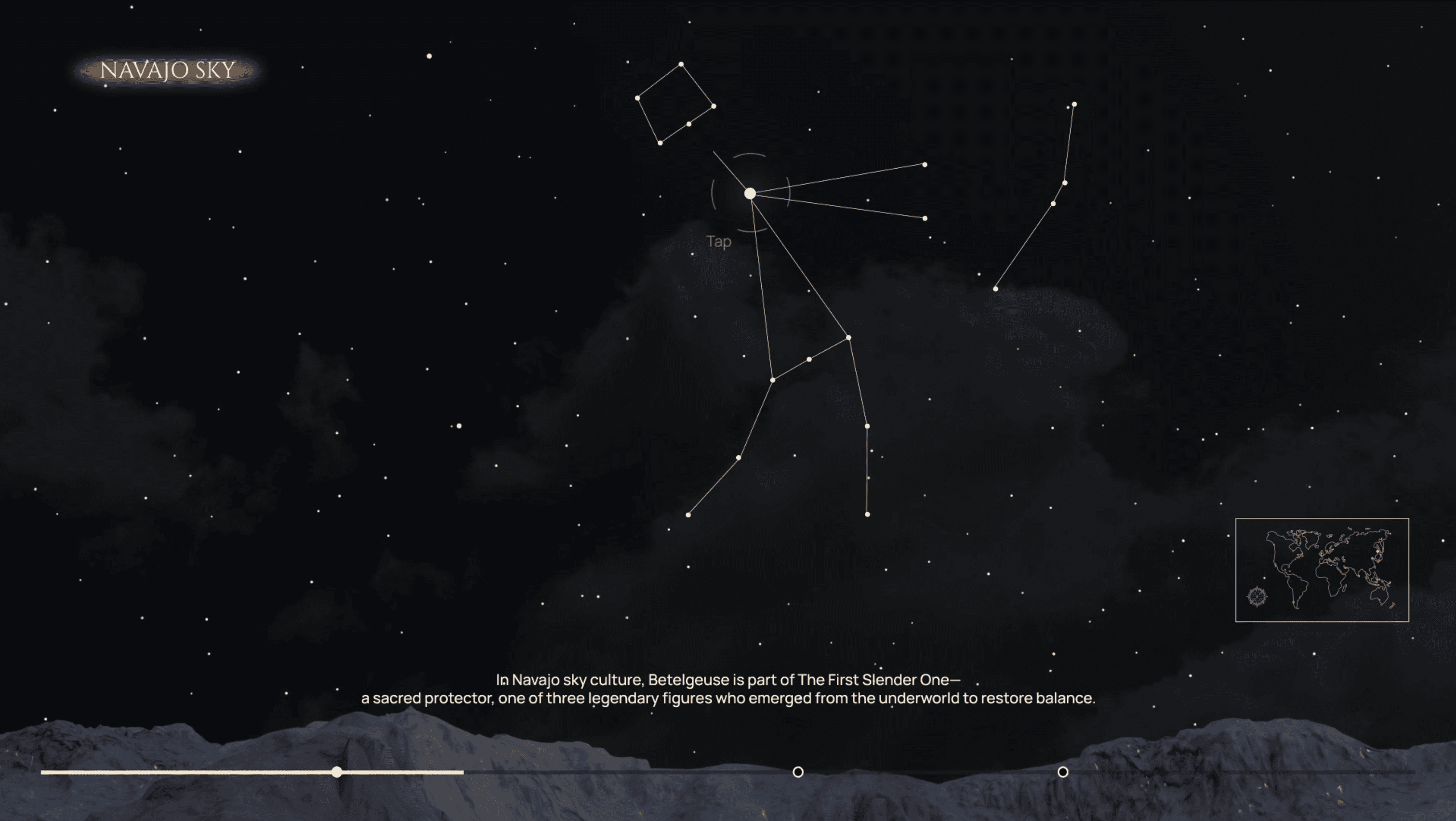
Clear visual prompts guiding users to tap Betelgeuse and transition between sky narratives
Readable typography and high contrast for visibility on a large public display
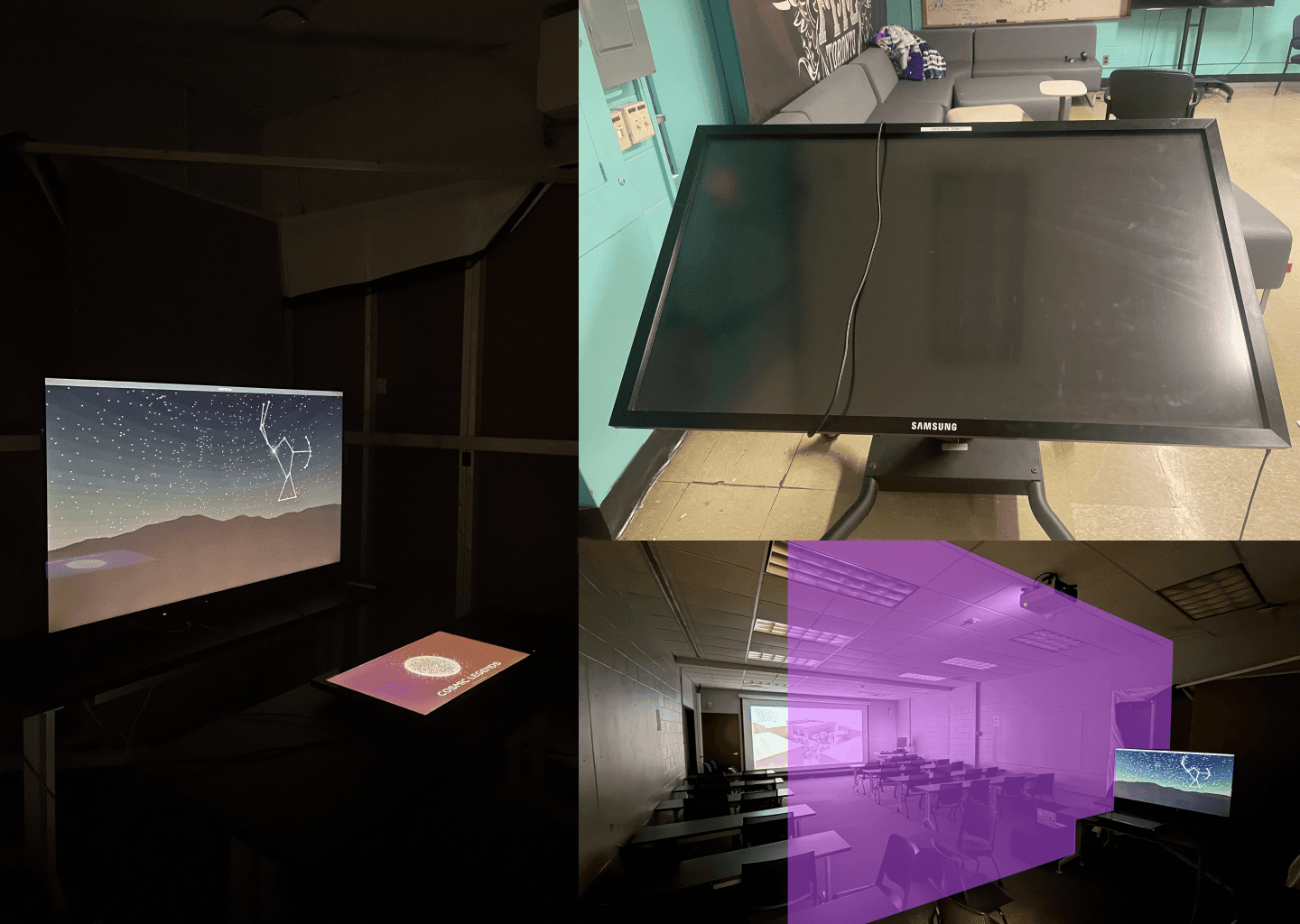
Above image displays the kiosk hardware and positioning it for users to interact in classrooms.
Translating Story into Interaction
Another challenge was translating oral and symbolic narratives into interface behavior. Cultural myths are rarely linear; they rely on metaphor, rhythm, and atmosphere. Rather than presenting stories as text blocks, the interface uses visual transitions, motion, and narration to allow users to experience the sky as a shifting cultural perspective.
This required balancing three layers simultaneously:
cultural accuracy
visual storytelling
usability in a short interaction window.
Scalability and Modular Design
The system was designed with modularity in mind, allowing additional cultural sky modules to be integrated without redesigning the entire experience. This approach makes the project adaptable for future expansion, including new stars, additional cultures, and AI-driven narrative pathways.
Future Possibilities 🔮
Cosmic Legends was designed to grow. The modular architecture means new stars, new cultures, and new languages can be added without rebuilding from scratch. The next evolution would bring multilingual narration in native languages with regional voice actors, an expanded star library drawing from African, Oceanic, Indian, Chinese, and Inuit traditions, and AI-driven storytelling that personalizes myth journeys based on what a user is curious about. Ultimately the vision is school curriculum kits and classroom kiosks — bringing cultural astronomy into everyday education. The sky belongs to everyone. This is just the beginning of telling its stories.
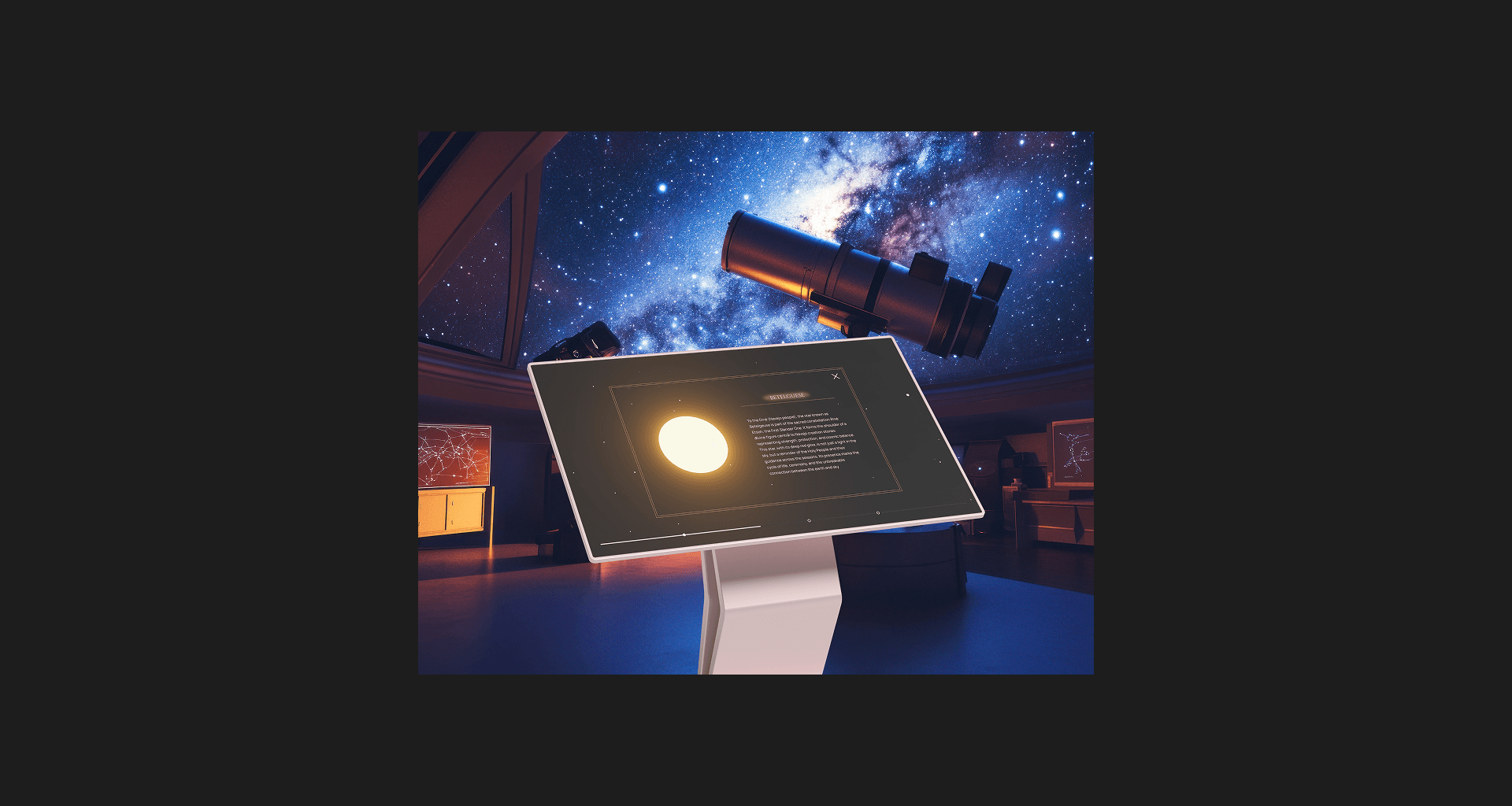
Public Showcase
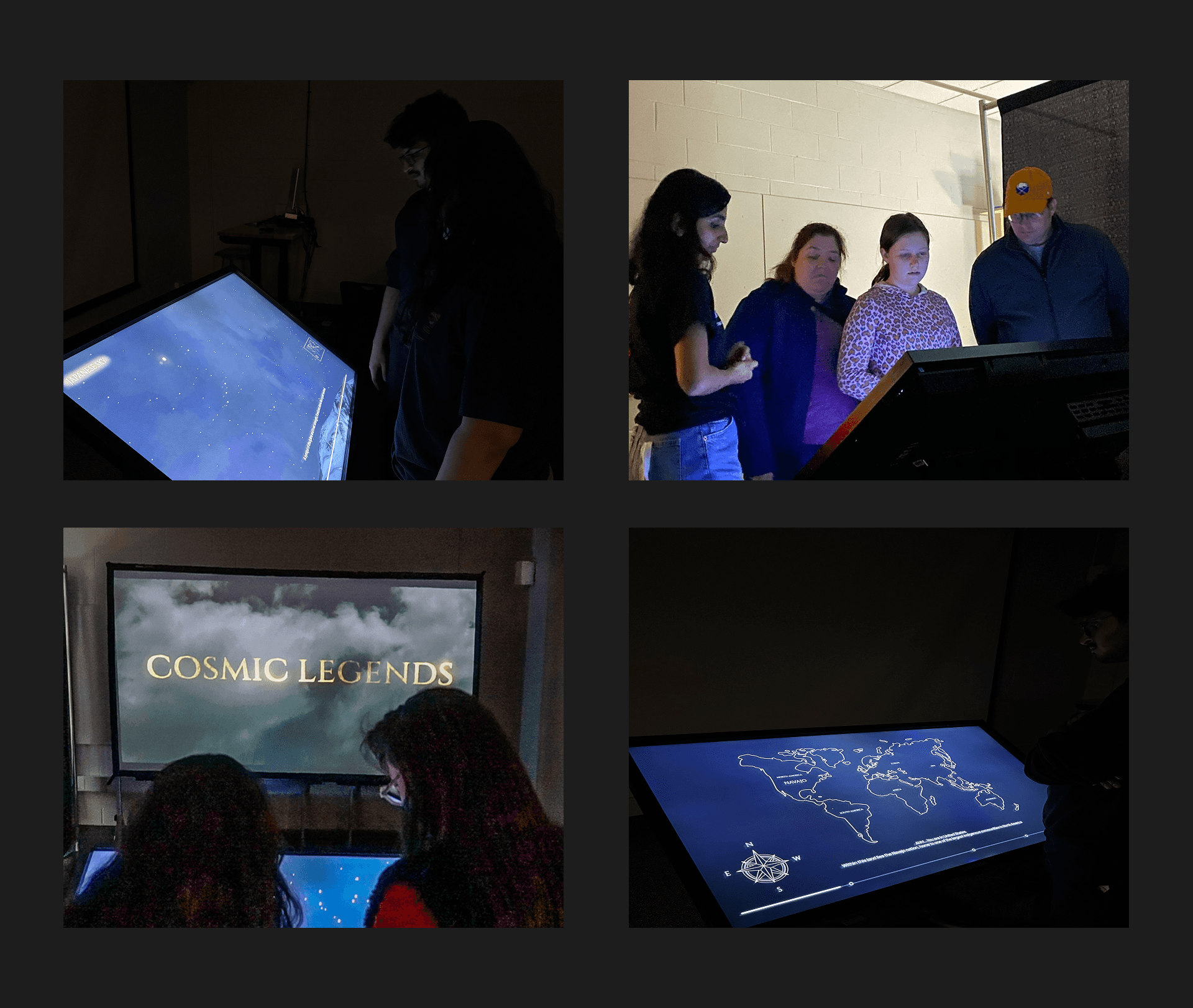
Insights
This project highlighted how emotionally resonant interfaces emerge when research, accessibility, and narrative are treated as equally important design inputs. It also emphasized the power of speculative features (like AI storytelling) to extend cultural relevance and imagination. Because the sky belongs to all of us and so do its legends, it’s a constellation of stories waiting to be retold.
Outcome and Impact 🏆
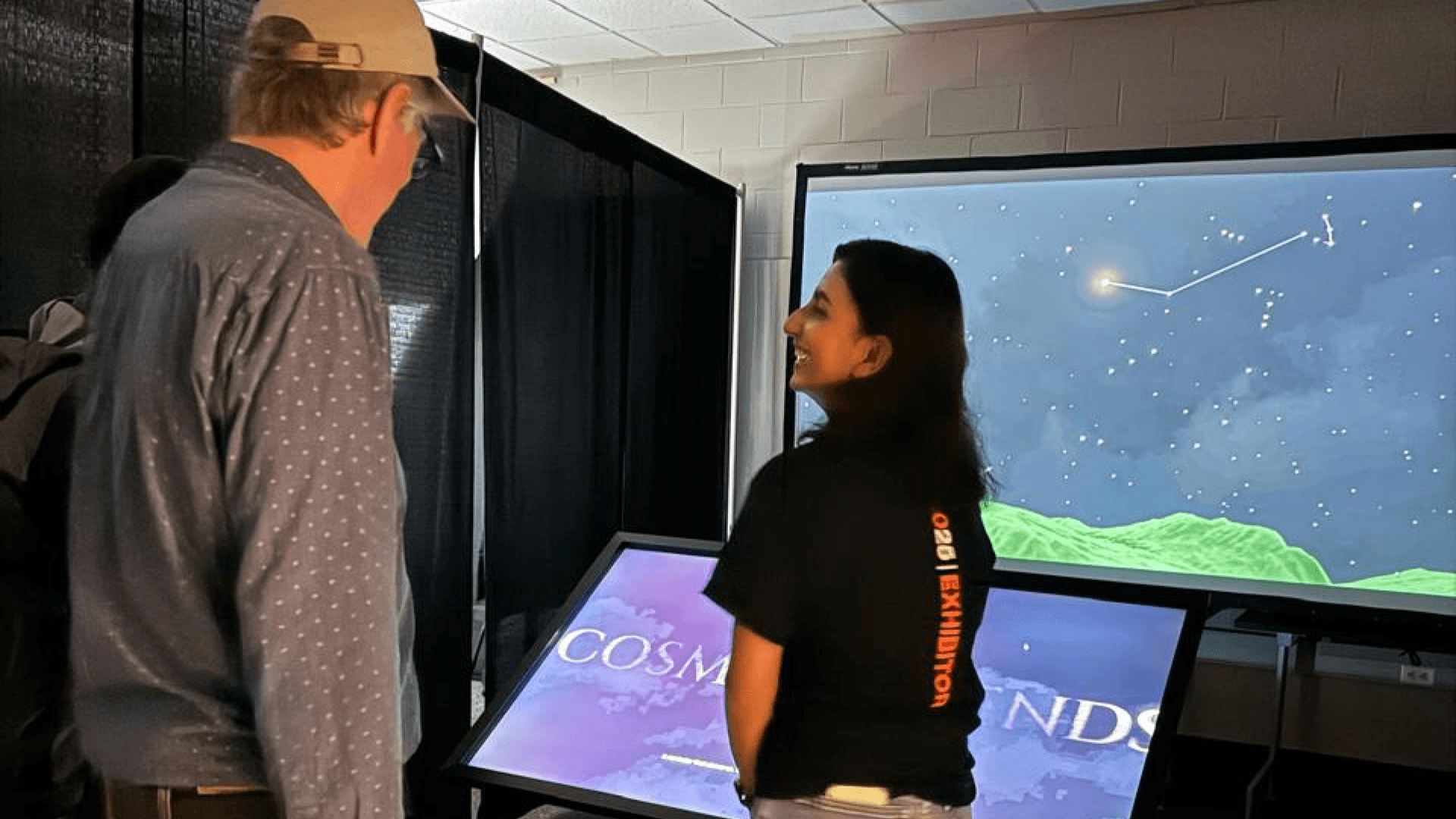
Cosmic Legends was publicly exhibited at Imagine RIT, where it was experienced by live audiences interacting with the kiosk in real time — validating the design in a genuine public environment, not just a classroom.
The project went on to win two independent industry awards — the SF Design Week Innovation Award 2026 and the Graphis New Talent Award 2026 — recognizing it as outstanding work in interaction, cultural storytelling, and experience design.
Beyond the awards, the work demonstrated a complete industry-relevant design workflow: research synthesis, interface design, motion prototyping, voice-driven accessibility, and large-format touchscreen UX. That combination of skills directly led to being hired as Lead UX Designer at MAGIC Spell Studios, where the same thinking was applied to real client products for the University of Rochester Medical Center.